

What is ‘reasonable punishment’?
In the UK, it is illegal to smack your child in Wales and Scotland, but not in England or Northern Ireland. The government’s argument is that parents should be trusted to discipline their own children and smacking may be used as ‘reasonable punishment’. There is a long list of factors that would constitute an ‘unreasonable’ smack – in short, it shouldn’t leave a mark.
The debate around banning smacking in England and NI rages on. And it raises several questions. What is ‘reasonable punishment’? What is ‘discipline’? If we don’t smack (and the vast majority do not), what options do we have instead? If we ‘spare the rod’, do we ‘spoil the child’? Might we end up at the other extreme: as helicopter parents wrapping our children in cotton-wool and turning them into snowflakes?
Punishment and its alternatives
The definition of punishment is to ‘inflict a penalty’, usually (but unfortunately not always) in response to a misdemeanor. Already we can begin to see some flaws in the punishment approach. Can we always be sure the person was responsible for the misdemeanor? And does the punishment always fit the crime?
When I think about punishment and its alternatives, I represent them on a grid:
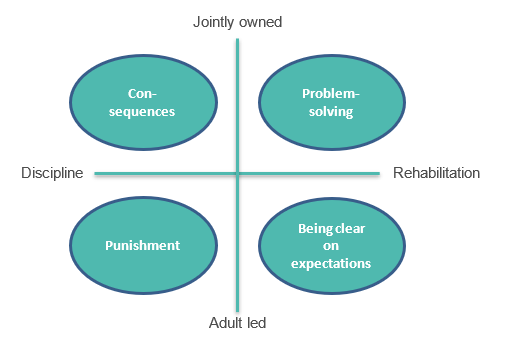
The horizontal dimension describes the extent to which the intervention is intended to discipline, at one end, or rehabilitate, at the other. Discipline (which comes from the Latin ‘to teach’) is concerned with helping the child to understand what they have done wrong. It is past-focused. Rehabilitation is about helping the child or young person to understand how they can behave differently next time. It is future-focused.
The vertical dimension describes the ‘locus of control’, i.e. where the power is. Does the choice of the intervention come from the adult or is it more of a negotiated process between the adult and the child? We all know, by the way, that we are much more likely to engage with a suggestion if we have been involved in its formation.
Adult-led approaches
Punishment is an adult-led, past-focused intervention that aims to teach (or often, more accurately, ‘to teach a lesson’). When a penalty is inflicted on a young person – they are grounded, or have a favourite toy taken away – their focus is on the unfairness of the situation and very definitely not on considering how they might behave differently next time.
A more future-focused approach, where the locus of control remains with the adult, is to state your expectations of behaviour: “When I lend you my tools / make-up / bike, I expect you to return it in good condition. I feel annoyed that you haven’t taken care of my stuff.” Whilst this may seem ‘weak’ in comparison to a penalty, be assured that the young person will be much more focused on behaving differently next time (in case they don’t get to borrow your stuff again).
Jointly owned approaches
Allowing your child to experience the consequences of their own actions is a discipline-led approach which encourages them to understand their own responsibility and agency. A consequence is ‘something that follows logically or naturally from an action’. Here’s an example: your teenager forgets to tell you that they need a lift to a school event; you have another commitment and are unable to take them. A consequence of their action (forgetting to tell you) could be that they have to find themselves a lift or pay for / contribute to the Uber fare.
Whilst this may feel similar to a punishment or penalty, there is a clear link between the young person’s own action and the follow-on consequence. It is much more difficult for them to challenge the logic of a consequence and, although they will still be seriously disgruntled, it encourages accountability in future. Much more so than an unconnected penalty such as “Because I’ve now got to pay for an Uber, you can’t go to that party on Saturday.”
Problem-solving is the ideal alternative to punishment. It is a jointly owned and future-focused exercise that truly focuses both the child and you on what could be happening differently. When my daughter was 9 or 10, we got into terrible arguments about her being on her phone when she got home from school. One of our house rules was ‘homework and chores first; play second’ when they got home.
I decided to take a problem-solving approach, which went something like this:
Me: Grace*, I notice that you’re on your phone again when we’ve agreed you should do homework first. Can we chat about this?
Grace: But everyone else goes on their phones when they get home, so by the time I get to the conversation I’ve missed all the banter. It’s no fun and it’s not fair.
Me (understanding dawning!): I can understand that. You feel as though you’re missing out. And I’m concerned that you’re not getting your homework done. What can we do about that?
Next, we jointly brainstormed a number of suggestions that we thought might work. I was careful to write down everything that Grace suggested, even if I didn’t like it. Actually, especially if I didn’t like it. She found that highly entertaining and it built her trust in the process.
Me: OK, I’m not sure I can ‘Get off your case completely and leave you to manage your own phone use’. You’re only 10. And you probably don’t like the suggestion of ‘Only having your phone at weekends’. But I quite like the idea of you having a set 30 minutes when you get home to be on your phone and then you give it to me and do your homework. What do you think?
Grace: Yeah, I think that could work.
And it did 😊.
What next?
If you are interested in learning more, book a 1:1 session with Julia via the The Wellbeing Hub, visit https://jpleadershipcoaching.co.uk/services/ or call Julia on 07967 497779.
* Name changed.